MemoHoney Official Website › Benefits
BenefitsMemoHoney Benefits: what the label is allowed to claim
The seller names five supports: memory function and cognitive health, protection from oxidative stress and mental clarity, neural communication and brain performance, long-term brain health with focus and concentration, and neurotransmitter production. All five are structure/function statements. This page takes each one and says what evidence sits behind it.
Five claims, read one at a time, with the research each one leans on.
The five supports named on the MemoHoney sales page
| What the seller says | What sits behind it | How this desk reads it |
|---|---|---|
| Enhance memory function and support overall cognitive health | The broadest of the five and the hardest to support. No trial of this formula exists. The nearest thing in its own ingredient list is a beta-alanine imaging study in adults aged 60 to 80 at 2.4 g a day, which measured white-matter structure rather than memory itself. | Weak, and indirect |
| Protect the brain from oxidative stress and improve mental clarity | Oxidative stress is not something any of the six ingredients is a recognised antioxidant for. Niacin feeds NADPH, which the body uses in its own antioxidant systems, and that is the closest link on this label. Mental clarity is not a measurable endpoint in any of the cited trials. | Mechanistic at best |
| Boost neural communication and promote better brain performance | Nitric oxide is a genuine signalling molecule in the nervous system as well as the vasculature, so this one has a real mechanism behind it. What it does not have is a human trial showing the effect from an oral capsule of this size. | Real mechanism, no outcome trial |
| Support long-term brain health and improve focus and concentration | The blood-pressure evidence is the strongest thing on this page and it belongs here: citrulline lowers blood pressure in middle-aged and older adults, and blood pressure treatment reduced probable dementia in a large randomised trial. That is two steps, not one, and the second was achieved with medicines. | Two steps removed |
| Optimize neurotransmitter production and contribute to a sharper mind | Amino acids are precursors for many things, but none of the six here is a direct precursor of a classical neurotransmitter. This is the claim on the list with the least behind it, and it is the one a reader should discount first. | Nothing specific behind it |
Structure/function statements. None of them is a claim to treat, cure or prevent anything, and nothing on this website upgrades them.
Printing that table is an odd thing for a retail counter to do and it is deliberate. A reader who buys on the strength of the fifth claim and later works out that there is nothing behind it stops trusting the other four, and the fourth one is genuinely interesting.
The fourth is worth dwelling on. The 2025 meta-analysis found citrulline lowered blood pressure in exactly the age group this product is marketed to, and SPRINT MIND found that treating blood pressure intensively reduced the rate of mild cognitive impairment. The gap between those two facts is enormous — one used medicines to a target, the other used an amino acid at grams a day — but the direction of travel is the same, and it is the most defensible thing on the bottle.
What the front of the MemoHoney bottle actually prints
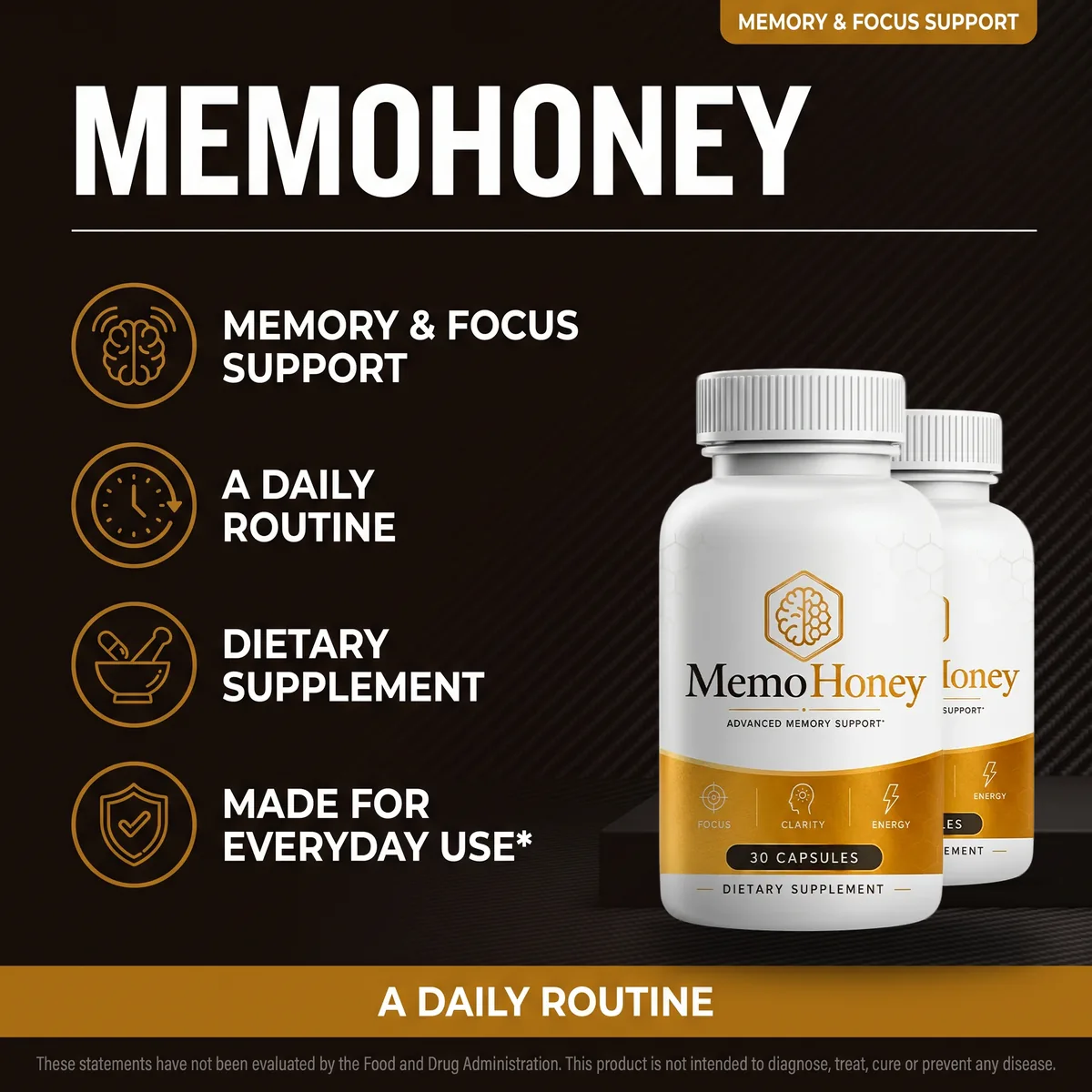
- Advanced Memory Support — the headline claim, with an asterisk that carries the FDA disclaimer
- Focus — one of three words on the gold band
- Clarity — the second
- Energy — the third, and the one most likely to be misread as a stimulant
- 30 Capsules — the count
- Dietary Supplement — the legal category, and the ceiling
That is the whole vocabulary of the front label. Six phrases, one asterisk. It is a restrained piece of design by the standards of this category, and the restraint is worth crediting: there is no clinically proven, no doctor recommended beyond the emblem discussed on the testing page, and no number that implies a result.
Energy is the one word worth defusing. In this formula it refers to niacin's role in the NAD and NADP coenzymes, which carry electrons in energy metabolism. It is not caffeine, there is no stimulant on the ingredient list, and nobody should take this capsule expecting the feeling a coffee gives.
Benefits MemoHoney is not claiming, and should not be read as claiming
- It is not a treatment for memory loss, dementia or Alzheimer's disease, and nothing on the bottle says otherwise.
- It does not claim to reverse anything. Every one of the five supports is written in the language of support rather than repair.
- It makes no speed claim. There is no works in days anywhere on the artwork, and the distributor's own review summary points at weeks.
- It is not a nootropic in the stimulant sense. No caffeine, no racetam, and — unlike some products in this aisle — no unapproved drug, which is a claim worth checking rather than assuming.
That last point deserves its own sentence because it has a real literature. An analysis published in 2022 found the unapproved drug centrophenoxine in dietary supplements sold for cognitive enhancement. Products whose ingredient lists read like pharmacology are the ones worth being careful about. Six amino acids and a B vitamin are, by comparison, an unglamorous and reassuring list.
How MemoHoney claims compare with the rest of the memory aisle
| Type of product | What it usually claims | What it usually prints |
|---|---|---|
| Standardised botanical (ginkgo, bacopa) | The same structure/function language, often with a named extract ratio | An amount and a standardisation percentage, because the extract is the product |
| Phospholipid (citicoline, phosphatidylserine) | Attention and memory support, sometimes with a branded ingredient trademark | A milligram figure, because the branded ingredient's own trials are the selling point |
| B-vitamin complex | Normal psychological function, under the wording the vitamin rules allow | Amounts and percent Daily Values, because vitamins have reference intakes |
| Omega-3 oil | Brain and heart support | EPA and DHA in milligrams, because the ratio is what buyers compare |
| MemoHoney | Memory, clarity, neural communication, long-term brain health | Six ingredient names and two counts: thirty capsules and six ingredients |
A comparison of disclosure conventions, not of effectiveness. Printing an amount does not make a product work; it makes it comparable.
The row that stands out is the last one, and it stands out for a structural reason rather than a sinister one. The other four categories are built on ingredients whose identity is the selling point, so the number goes on the front of the box. A blend of commodity amino acids has no branded extract to advertise and no reference intake to quote against, so the convention that would force a figure onto the label is simply absent.
The consequence for a buyer is real all the same. You can put two ginkgo products side by side and work out which is better value in about ten seconds. With this one you cannot, and that is worth factoring into the price rather than arguing about.
Why MemoHoney is allowed to say what it says
Dietary supplements in the United States occupy a specific legal space. They may make structure/function claims — statements about supporting the normal working of a part of the body — and they may not make disease claims. Supports memory function is the first kind. Treats memory loss would be the second, and it would make the product an unapproved drug.
That is the whole reason the asterisk exists on the front of the bottle, and the reason the FDA disclaimer appears at the foot of every page here. The claim and the disclaimer are a pair: the seller is permitted the first only if it carries the second. The FDA's own questions and answers set out what that permission covers and what it does not.
Two practical consequences follow. A supplement label that reads like a prescription is either breaking the rules or is not a supplement; and a structure/function claim, by itself, tells you nothing about whether a product works. It tells you which shelf it is on.
Sources behind this MemoHoney claims page
- Luo P, Chen J, Liu K, et al. Does l-citrulline supplementation and watermelon intake reduce blood pressure in middle-aged and older adults? A systematic review and meta-analysis of randomized controlled trials. Clin Nutr ESPEN. 2025;69:653-664. PMID 40789388. https://pubmed.ncbi.nlm.nih.gov/40789388/
- Williamson JD, Pajewski NM, Auchus AP, et al. Effect of Intensive vs Standard Blood Pressure Control on Probable Dementia: A Randomized Clinical Trial. JAMA. 2019;321(6):553-561. PMID 30688979. https://pubmed.ncbi.nlm.nih.gov/30688979/
- Ostfeld I, Zamir A, Ben-Zeev T, et al. β-Alanine supplementation improves fractional anisotropy scores in the hippocampus and amygdala in 60-80-year-old men and women. Exp Gerontol. 2024;194:112513. PMID 38971131. https://pubmed.ncbi.nlm.nih.gov/38971131/
- Cohen PA, Avula B, Khan I. The unapproved drug centrophenoxine (meclofenoxate) in cognitive enhancement dietary supplements. Clin Toxicol (Phila). 2022;60(10):1156-1158. PMID 35959800. https://pubmed.ncbi.nlm.nih.gov/35959800/
- Questions and Answers on Dietary Supplements. U.S. Food and Drug Administration. https://www.fda.gov/food/information-consumers-using-dietary-supplements/questions-and-answers-dietary-supplements
- DeKosky ST, Williamson JD, Fitzpatrick AL, et al. Ginkgo biloba for prevention of dementia: a randomized controlled trial. JAMA. 2008;300(19):2253-62. PMID 19017911. https://pubmed.ncbi.nlm.nih.gov/19017911/
Order MemoHoney with the claims read honestly
Five supports, ranked by what actually sits behind them. Packs run from two bottles to six, and the sixty-day window applies to all three.
Two bottles $158 · six bottles $294 · 60-day money-back guarantee
Order MemoHoney From This CounterLot MEM-26/ME-7435 · one a day, 30 to a bottle · ships from the United States