MemoHoney Official Website › Disclaimer
DisclaimerMemoHoney Disclaimer: the claims ceiling in one place
These statements have not been evaluated by the Food and Drug Administration. This product is not intended to diagnose, treat, cure or prevent any disease. It is a dietary supplement rather than a drug, it is not FDA-approved, and it is for healthy adults aged 18 and over. Memory that has changed in a way others have noticed deserves an assessment.
Everything this website will not claim, gathered into one page.
The MemoHoney FDA statement, and what it means
The sentence at the foot of every page on this site is not decoration and it is not a formality. It is the condition on which a dietary supplement is permitted to say anything at all about supporting a part of the body.
A supplement may make structure/function claims: statements about supporting the normal working of something. It may not make disease claims. The asterisk on the front of the bottle and the disclaimer at the foot of these pages are a matched pair, and the FDA's questions and answers set out the boundary between the two.
The practical consequence for a reader is worth stating plainly. Nothing sold here has been through the evaluation a medicine goes through. No regulator has reviewed this formula for efficacy, and the ingredient amounts have not been published by the manufacturer. That is the category, and it is the same category as every other supplement on every other shelf.
What MemoHoney is not
- Not a drug. A dietary supplement, sold and regulated as one.
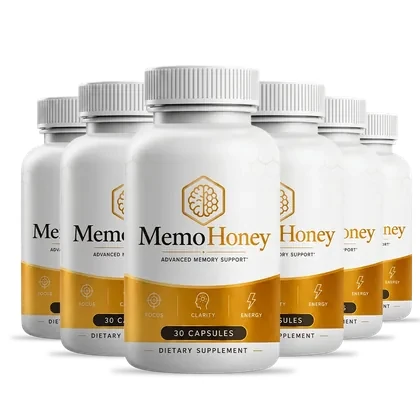
- Not FDA-approved. The FDA does not approve dietary supplements, and the registration emblem on the pack is a statement about a facility.
- Not a treatment. Not for memory loss, not for dementia, not for Alzheimer's disease and not for any other diagnosed condition.
- Not a stimulant. No caffeine and nothing caffeine-like. The word energy on the band refers to niacin's role in energy metabolism.
- Not clinically trialled as a formula. No study of this product, or of this combination of six ingredients, exists.
- Not for anyone under 18. The label is written for adults.
That list is the reason several pages on this website point at things nobody here sells. Hearing treatment, blood pressure treatment and sleep all have evidence behind them for cognitive outcomes, and a supplement counter that never mentioned them would be leaving out the most useful thing it knows.
The MemoHoney precautions, in full
- A dietary supplement rather than a medicine, and a capsule rather than a gummy, a powder or a liquid.
- Not FDA-approved, and not intended to diagnose, treat, cure or prevent any disease.
- Written for healthy adults of 18 and over, and for nobody younger.
- The supplied artwork has no Supplement Facts panel on it, so how much of each named ingredient a capsule holds is a question for the seller rather than a figure this desk can quote or estimate.
- Memory that has changed in a way you or the people around you have noticed is worth having looked at properly, once. Six months on a capsule instead is six months.
- The amount on the bottle is the amount to take, unless a clinician who knows your history says otherwise.
- People differ, and so do outcomes. Sleep, hearing, blood pressure and how much you move all act on the same thing this formula is sold for, and all four have randomised evidence behind them.
- The star score, the review count and the order total on this website belong to the distributor. They are its own summary of its own sales rather than audited transcripts, and they are not evidence.
- Lot MEM-26/ME-7435 identifies a production run and MEM-7435-26-ME identifies a filing. Neither is a laboratory result.
- An email to the website address reaches an editor, not an order screen. Refunds start on the telephone.
- A money-back window is a promise about money. It says nothing about what the capsule will do.
What the MemoHoney review figures are and are not
The score of 4.8, the 1,130 written reviews, the 9,789 orders and the 87% recommendation rate are the distributor's own summary figures. They are not verified transcripts, they are not audited, and they are not evidence about the formula.
They are published on this website because a buyer will meet them on the seller's page anyway, and a page that omitted them without saying so would be quieter rather than more honest. The reviews page sets out how to read them and what they cannot tell you.
The same applies to the eight-name roster. Two distinct review bodies run across eight names, which is summary copy rather than eight separate voices, and it is the reason no individual review anywhere on this site carries structured-data markup.
Affiliate and commercial disclosure for MemoHoney
Memohoneya sells this product. Orders placed through the links on this website are orders with this counter, and this counter earns from them. That is the commercial relationship and there is nothing hidden about it.
What it does not buy is the content. The pages here print what the artwork does not carry, name the emblem this desk would drop, list three interventions with better evidence than the product being sold, and say plainly which of the seller's five claims has the least behind it. A site that could not do those things would not be worth reading, and a reader who could not tell the difference would be right to distrust all of it.
Every outbound citation on this website is to a public record or a government health page. None of them is an affiliate link, and none of them pays anything to this desk.
How to read the word “support” on a MemoHoney page
Support is the most-used word in this category and the most easily misread. It does not mean improve, it does not mean restore, and it does not mean a measured effect was found. In the legal sense it means the product is offered in relation to the normal working of something, and that is all it means.
This site uses the word because the label does and because the alternative would be to paraphrase a regulated phrase into something that sounds like more. Where a page can say something stronger and defend it, it does: the ingredients page prints amounts and populations, and the benefits page ranks the seller's five claims by what sits behind them.
A useful habit for reading any supplement page, this one included: every time you see supports, ask what was measured, in whom, and at what amount. If the page cannot tell you, the word was doing the work of a result it does not have.
What would change the claims on this MemoHoney website
- A published Supplement Facts panel. Several pages would be rewritten the day one arrives, and the comparison table would gain the column it is missing.
- A certificate of analysis from a named laboratory. It would move the testing page from describing emblems to reporting results.
- A trial of this formula. Anything randomised and placebo-controlled, at any size, would be the most significant thing on the site.
- A named clinician behind the emblem. One line of text would turn a graphic into a checkable fact.
- New evidence on any of the six ingredients. The citation set is dated, and a better-designed trial changes what the ingredient page says.
Listing the conditions under which a page would change is a reasonable thing for a publisher to do, and an unusual one. It is here because it turns the claims on this site into something falsifiable rather than something asserted, and because the first item on the list would improve the product as much as the website.
Sources behind this MemoHoney disclaimer
- Questions and Answers on Dietary Supplements. U.S. Food and Drug Administration. https://www.fda.gov/food/information-consumers-using-dietary-supplements/questions-and-answers-dietary-supplements
- Using Dietary Supplements Wisely. National Center for Complementary and Integrative Health, National Institutes of Health. https://www.nccih.nih.gov/health/using-dietary-supplements-wisely
- Memory. MedlinePlus, U.S. National Library of Medicine. https://medlineplus.gov/memory.html
- Lin FR, Pike JR, Albert MS, et al. Hearing intervention versus health education control to reduce cognitive decline in older adults with hearing loss in the USA (ACHIEVE): a multicentre, randomised controlled trial. Lancet. 2023;402(10404):786-797. PMID 37478886. https://pubmed.ncbi.nlm.nih.gov/37478886/
- Williamson JD, Pajewski NM, Auchus AP, et al. Effect of Intensive vs Standard Blood Pressure Control on Probable Dementia: A Randomized Clinical Trial. JAMA. 2019;321(6):553-561. PMID 30688979. https://pubmed.ncbi.nlm.nih.gov/30688979/
- Yasser E, Ayache L, El Khayat H, et al. Sleep and memory consolidation: Neural and cognitive perspectives. Prog Brain Res. 2026;299:137-176. PMID 42547206. https://pubmed.ncbi.nlm.nih.gov/42547206/