MemoHoney Official Website › Articles › Labels
LabelsA supplement label with no numbers
A Supplement Facts panel states a serving size and an amount for every ingredient, and it is the only part of a package that makes two products comparable. MemoHoney's supplied artwork carries six ingredient names, two counts and no panel, which costs a buyer comparison, dose arithmetic and value.
What a Supplement Facts panel is
A Supplement Facts panel is the ruled box on the back of a supplement bottle. It states a serving size, how many servings the container holds, every dietary ingredient with the amount per serving, and a percent Daily Value for anything that has one. Beneath it sits an other ingredients line: the capsule shell, the fillers, the flow agents.
It is the single most useful thing on any supplement package, and it is the only part that makes two products comparable. Without it, a shelf of bottles is a shelf of adjectives.
The FDA's own questions and answers on dietary supplements sets out what the category is and what the labelling rules cover.
MemoHoney is a dietary supplement and not a treatment. Nothing here is medical advice. Memory that has changed in a way you or the people around you have noticed deserves an assessment rather than a purchase, and MedlinePlus sets out what is worth reporting.
What this product's artwork carries instead
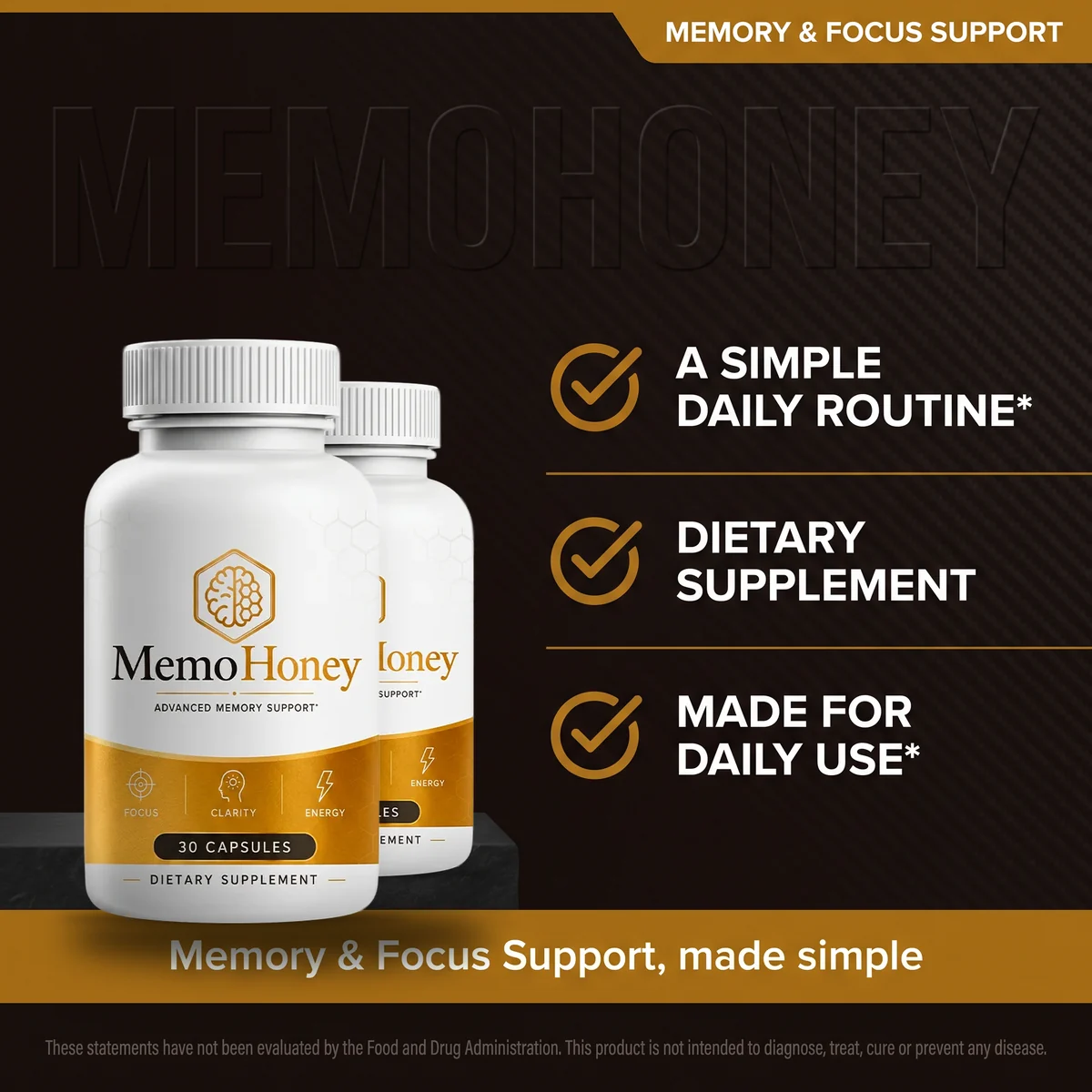
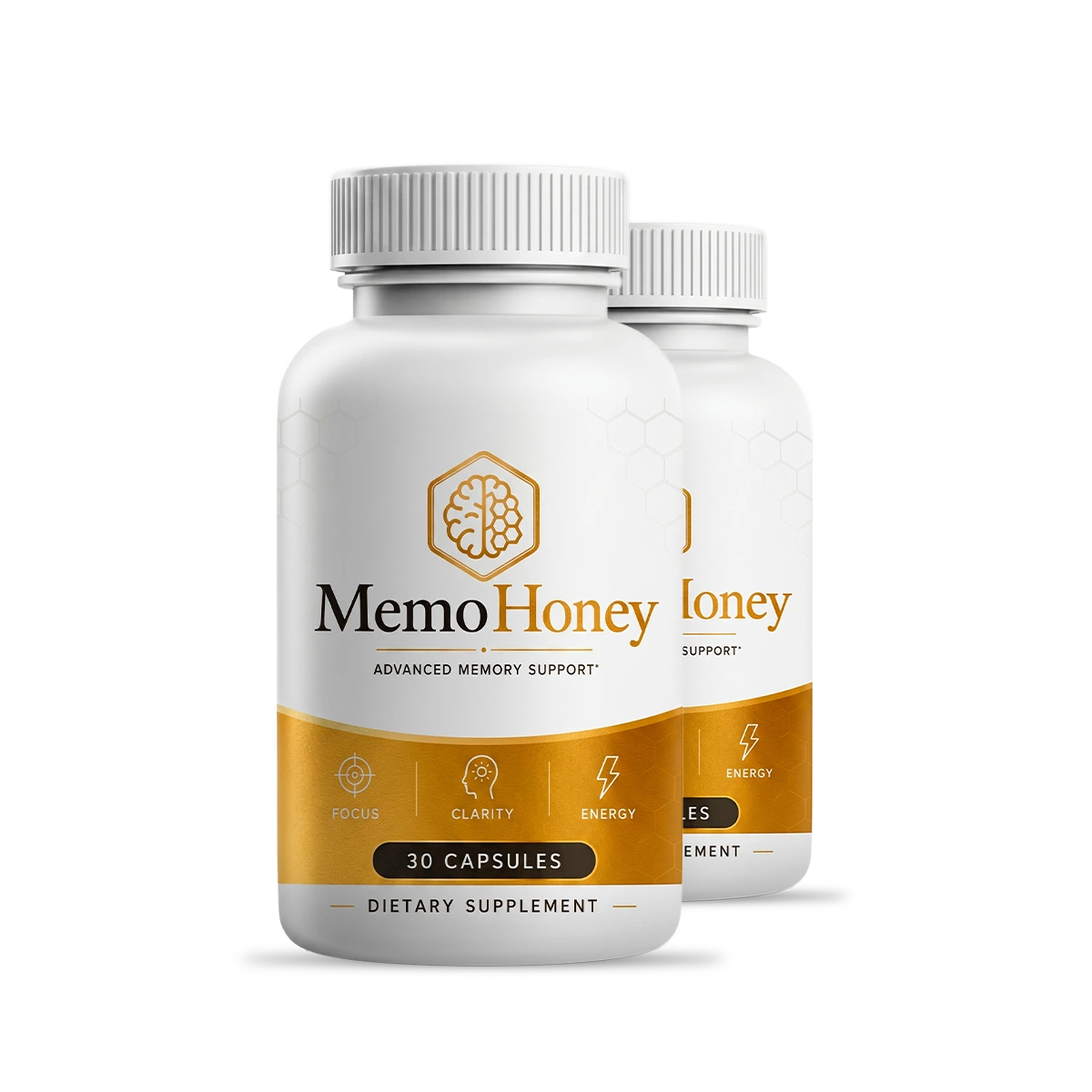
The artwork supplied with MemoHoney has no panel. The front of the bottle reads Advanced Memory Support under a brain set in a honeycomb hexagon, with a gold band naming focus, clarity and energy, then 30 capsules and dietary supplement. A separate tile graphic names six ingredients. A strip across its foot repeats the counts: thirty capsules, six named ingredients.
Those two counts are the only numbers anywhere in the supplied pack. There is no serving size in a box, no milligram against any of the six names, and no percent Daily Value.
The directions are a single line: take 1 capsule daily with a glass of water, preferably in the morning before a meal. That is clear and it is useful, and it is a different kind of information from a panel.
What the absence costs a buyer
Four specific things, none of them dramatic and all of them real.
- Comparison. Two ginkgo products can be compared in ten seconds because both print milligrams. Two products with no panel cannot be compared at all.
- Dose arithmetic. Niacin has a United States tolerable upper intake level of 35 mg a day. If you take a multivitamin as well, the total is yours to work out and one of the two figures is missing.
- Value. Price per bottle is meaningless without knowing what is in the bottle. A reader is left comparing the packaging.
- Conversation. A pharmacist asked about an interaction will want the amounts, and a photograph of the bottle will not give them any.
What it does not cost is safety, in any documented sense. The six names are commodity compounds with long histories of use, and the amounts a single capsule can hold are small by the standards of the research. The problem here is not danger; it is that a buyer cannot check what they are buying.
Proprietary blends, and the thing that is worse
There is a common label practice worth knowing about, because it looks like disclosure and is not. A proprietary blend prints several ingredient names followed by one total: Proprietary Cognitive Blend 500 mg, and then six names underneath it.
That is legal and it answers nothing. If four ingredients share 500 mg, one of them could be 480 mg and the other three a pinch each, and the label reads the same either way. The practice exists so that a competitor cannot copy a formula, which is a real commercial interest and is not the buyer's.
This product does not use a proprietary blend. It has no panel at all, which is a different situation: a blend tells you a total and withholds the division, while no panel withholds both. Neither is illegal and neither is what a reader wants.
Ask the MemoHoney seller for the panel
The batch page carries the exact wording to send, naming lot MEM-26/ME-7435, and says what a good reply looks like. It takes one email and the answer is worth having before a six-bottle order rather than after one.
Two bottles $158 · six bottles $294 · 60-day money-back guarantee
Order MemoHoney From This CounterLot MEM-26/ME-7435 · one a day, 30 to a bottle · ships from the United States
How to ask for it
Write rather than telephone, because the point is to have the answer in a form you can keep. Name the lot. Ask for the panel specifically: the serving size, the amount of each ingredient and the percent Daily Value where one applies. Say a photograph is fine, because it often is.
Three replies are possible and all three are informative. A panel is the good outcome. A straight statement that the manufacturer treats the formula as proprietary is an honest answer and tells you where you stand. A reply that restates the marketing is the third, and it is a data point about the seller rather than about the product.
The batch verification page has the wording written out, along with a second request for the certificate of analysis.
What a missing panel does to the price question
Value in this aisle is normally worked out per milligram: two ginkgo products at different prices are compared by dividing one by the other, and the comparison takes ten seconds.
Without a panel that arithmetic is unavailable, so the question changes shape. What you are left comparing is everything around the capsule — the refund window, whether a telephone number exists, how the seller answers a direct question, and how much of the price is packaging. Those are real things and they are worth money; they are just not the thing most buyers think they are paying for.
The pricing page does the only arithmetic this product allows: cost per day, pack against refund window, and the category's ordinary price bands for scale.
Why labels end up like this
It is tempting to read a missing panel as concealment. Usually it is something duller, and knowing which is which helps a buyer judge the seller rather than the graphic.
The commonest reason is contract manufacturing. A brand commissions a formula from a contract manufacturer, and the amounts belong to whoever wrote the specification. A brand that never asked for them, or that signed a confidentiality clause covering them, cannot publish what it does not hold.
The second reason is competitive. A published panel is a recipe, and a competitor can read it in a second. That is a real commercial interest, it is why proprietary blends exist, and it is not the buyer's interest.
The third is that artwork for a direct-to-consumer product is designed for a listing page rather than a shelf. Nobody picks this bottle up before buying it, so the design optimises for a thumbnail: a strong front, a tile graphic, four listing scenes. A panel photographs badly and adds nothing to a scroll, so it does not get made.
None of those three is sinister and none of them helps a reader. What they do explain is why asking politely often works: a seller who simply never printed the figure may still be able to obtain it.
Three things a panel would settle here
- The niacin. It is the only ingredient with a published ceiling — 35 mg a day in the United States — and the only one where the arithmetic across a reader's other products actually matters.
- The capsule shell. The other-ingredients line under a panel names the shell material. The vegetarian emblem on the front is currently the only statement either way.
- The split across six names. Four of the six feed one pathway, and whether that is four meaningful entries or one ingredient divided four ways is exactly what a column of milligrams would answer.
Three questions, one box, no change to the formula. That is the shape of the improvement available here, and it is why the testing and quality page treats a wall of ten emblems as a design decision about what to put in front of a buyer.
What a good label in this category looks like
| Element | What the best labels do | What this artwork does |
|---|---|---|
| Panel | A ruled Supplement Facts box on the back | No panel in the supplied artwork |
| Amounts | A figure against every ingredient | Six names, no figures |
| Form | The salt or the standardisation named | Named for four of the six: AKG 2:1, HCl, malate |
| Serving size | Stated in the panel | One capsule, stated in the directions |
| Other ingredients | Shell, fillers and flow agents listed | Not in the supplied artwork; the vegetarian emblem is the only statement about the shell |
| Claims | Support language with the disclaimer beside it | Support language, with the asterisk carrying the disclaimer |
Four of the six rows are things this artwork could add without changing the formula at all.
That table is the fairest summary this article can offer. The label is not dishonest, it is not making claims it should not, and its directions are clearer than most. What it does not do is let a reader check anything, and that is a design decision rather than an accident.
It is also the single cheapest improvement available to this product. Six figures on one bottle face would change several pages on this website and would put the formula in a position to be compared, which is the position a good formula wants to be in.
- Questions and Answers on Dietary Supplements — published by U.S. Food and Drug Administration, read on the publisher’s own site (www.fda.gov)
- Using Dietary Supplements Wisely — published by National Center for Complementary and Integrative Health, National Institutes of Health, read on the publisher’s own site (www.nccih.nih.gov)
- 2017: Definition of a tolerable upper intake level of niacin: a systematic review and meta-analysis of the dose-dependent effects of nicotinamide and nicotinic acid supplementation — Minto C and co-authors (Nutr Rev 2017;75(6):471-490), PubMed record 28541582
- 2003: Varying cost and free nicotinic acid content in over-the-counter niacin preparations for dyslipidemia — Meyers CD and co-authors (Ann Intern Med 2003;139(12):996-1002), PubMed record 14678919
- 2022: The unapproved drug centrophenoxine (meclofenoxate) in cognitive enhancement dietary supplements — Cohen PA, Avula B and Khan I (Clin Toxicol (Phila) 2022;60(10):1156-1158), PubMed record 35959800
- 2008: Ginkgo biloba for prevention of dementia: a randomized controlled trial — DeKosky ST and co-authors (JAMA 2008;300(19):2253-62), PubMed record 19017911
- Memory — published by MedlinePlus, U.S. National Library of Medicine, read on the publisher’s own site (medlineplus.gov)