MemoHoney Official Website › Articles › Ingredients
IngredientsCitrulline for memory: what the trials actually used
Citrulline is the best-supported ingredient on this label and the one with the widest gap between study and capsule. Trials used 8 to 12 grams a day, mostly in athletes, and the strongest finding is a blood-pressure effect in middle-aged and older adults rather than anything measured about memory.
Why citrulline exists as a supplement at all
Nitric oxide is made from arginine, so the obvious supplement is arginine. The problem is that swallowed arginine meets arginase in the gut wall and again in the liver, and a large share of a dose never arrives in the blood as arginine.
Citrulline is the workaround. It is absorbed intact, passes the liver largely untouched, and is converted to arginine in the kidney. A human study gave ten volunteers 0.18 g per kilogram a day — about 12 g for a 70 kg adult — and watched plasma arginine double, with under one per cent of the citrulline load lost in urine.
That is the whole reason two of the six names on this label are citrulline. A 2019 review puts it plainly: citrulline is roughly twice as potent as arginine at raising plasma arginine, because of that lower first-pass loss.
MemoHoney is a dietary supplement and not a treatment. Nothing here is medical advice. Memory that has changed in a way you or the people around you have noticed deserves an assessment rather than a purchase, and MedlinePlus sets out what is worth reporting.
What the citrulline trials actually used
| Study | Amount | For how long | In whom | Outcome measured |
|---|---|---|---|---|
| Cerebrovascular function | 8.8 g a day | Five days | Taekwondo athletes | Cerebrovascular function during sprint interval training |
| Repeated sprints | 8 g a day | Three days | Male team-sport athletes | Sprint performance decrement |
| Moderate versus high dose | 8 g and 12 g | Acute, one hour before | Trained individuals | Barbell rows and leg presses |
| Older women | 3 g a day | Six weeks with exercise | Women aged 60 to 75 | Lower-limb function |
| Availability | 0.18 g per kg a day | One day | Ten healthy volunteers | Plasma, red-cell and urinary citrulline |
| Blood pressure meta-analysis | Varied | Varied | Middle-aged and older adults | Systolic and diastolic blood pressure |
Six studies, and the smallest daily amount anywhere in them is three grams — which arrived with a six-week supervised exercise programme attached.
Read the last column as carefully as the second. Only one of those six measured anything to do with the brain, and it did so in athletes during hard exercise, which is a state in which cerebral blood flow is under an unusual demand. Nobody has run the equivalent study in an ordinary adult at rest.
That is not a criticism of the ingredient. It is a description of where the evidence sits, and it is the difference between saying citrulline has been studied for the brain and saying citrulline improves memory.
The evidence that is strongest, and least advertised
The best-supported thing citrulline does is lower blood pressure. A 2025 systematic review and meta-analysis of randomised trials found citrulline supplementation and watermelon intake lowered blood pressure in middle-aged and older adults, and that citrulline taken with arginine outperformed either one alone.
That last detail is worth pausing on, because this label carries both. Two arginine entries and two citrulline entries is, whatever else it is, the pairing the meta-analysis found most effective.
Why it is not advertised is obvious once stated: a blood-pressure claim on a supplement sold for memory would be a disease claim, and a supplement may not make one. So the strongest evidence behind the formula is the one thing the front of the bottle cannot mention.
If you take a blood-pressure medicine, a nitrate or a PDE5 inhibitor, the mechanism here works on the same pathway yours does. That is a conversation to have with whoever prescribes it, before the first capsule rather than after a light-headed morning. The side effects page names the three classes.
Why two citrulline forms, and does it matter
L-Citrulline HCL is citrulline with hydrochloride, a salt that keeps it stable and soluble. L-Citrulline Malate is citrulline bound to malic acid, an intermediate in the citric acid cycle. Both deliver citrulline; the malate brings malic acid along with it.
The sports literature uses malate more often, largely for historical reasons, and the two are not usually compared head to head at matched citrulline content. Anyone claiming a large difference between them is going beyond what has been tested.
What splitting a pathway across two names does achieve reliably is a longer ingredient list. On a label that prints no amounts, four entries feeding one mechanism look like four ingredients and could be one ingredient divided four ways. That is not an accusation; it is the thing a panel would settle in a second.
What a capsule changes
Every amount in the table above came out of a scoop. Citrulline powder is sold by the kilogram and eight grams is a rounded teaspoon of it in a glass of water. A capsule is a much smaller container, and on this label six ingredients are sharing one.
This desk will not convert that into a milligram figure and present it as a fact, because the artwork does not support one. What can be said is that the arithmetic gap between a gram-scale trial and a shared capsule is the central question about this product, and that it is answerable by the seller in one email.
If knowing the amount matters to you, buying citrulline as a powder is cheaper and gives you the figure. If a once-daily capsule with a phone number and a refund window is what you want, this is what that costs. Both are reasonable; they are not the same purchase.
Read the MemoHoney ingredient page before you decide
Every one of the six names is set beside the amount its published trials used, with the population and the outcome attached. It is the page this article exists to point at.
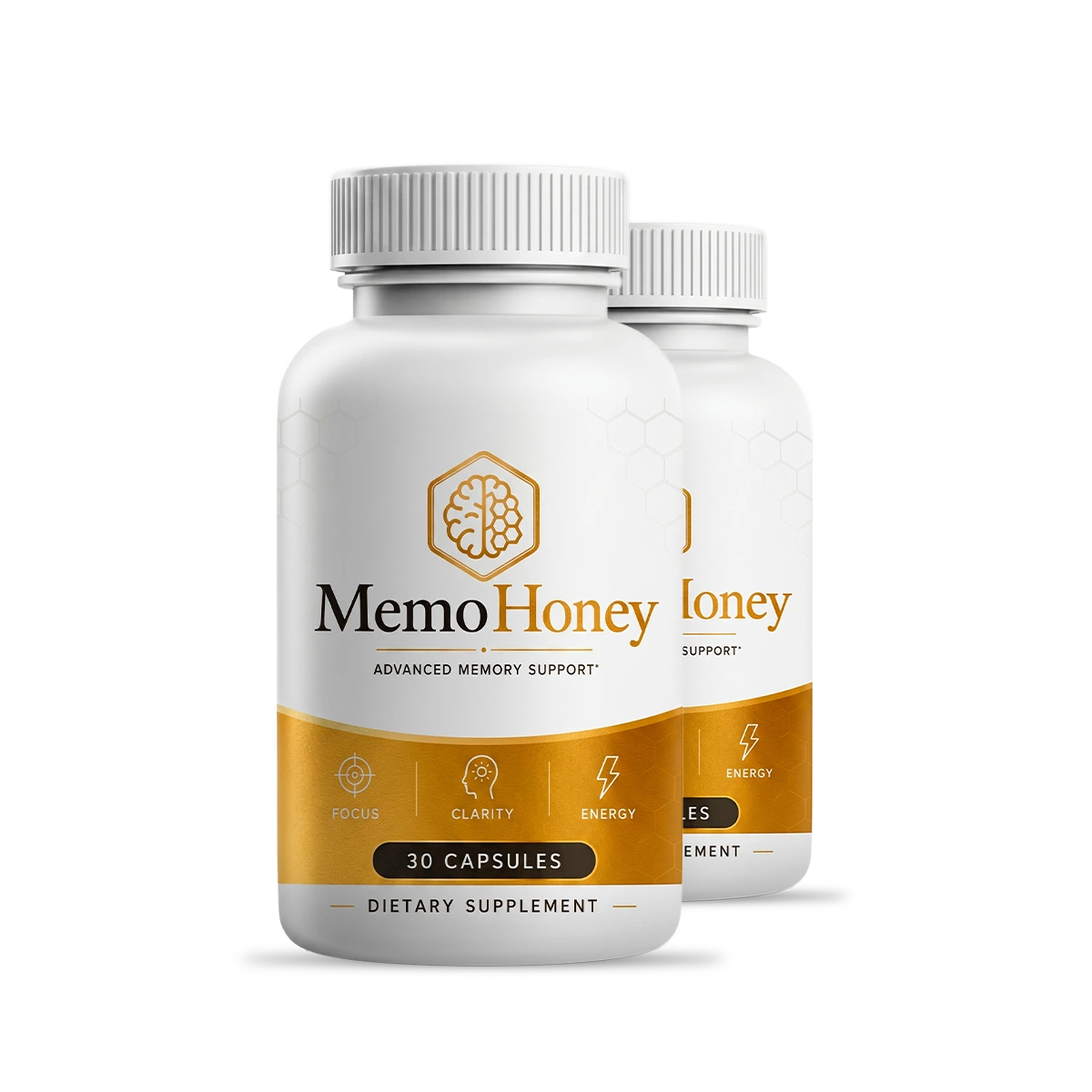
Two bottles $158 · six bottles $294 · 60-day money-back guarantee
Order MemoHoney From This CounterLot MEM-26/ME-7435 · one a day, 30 to a bottle · ships from the United States
What the arginine entries add, and what they do not
If citrulline is the better arginine precursor, why does this label carry arginine as well? Two answers, one good and one commercial.
The good one comes out of the evidence. The 2025 meta-analysis found citrulline combined with arginine outperformed either alone on blood pressure, and a pharmacokinetic study found that taking the two together raised plasma arginine faster than either did by itself. A formula carrying both is following that finding rather than padding a list.
The commercial one is that four amino acid names look like more than two. On a label with no amounts, there is no way for a reader to tell which explanation is operating, and that is the recurring difficulty with this particular bottle.
What arginine on its own has not shown is a performance effect. A randomised trial gave an arginine AKG supplement four hours and again thirty minutes before exercise and found no change in muscle endurance or in blood pressure response. A single 3 g dose before one session did nothing measurable either. The arginine story is a blood-pressure story, not a performance one.
Where citrulline does not help
It is worth being as clear about the limits as about the evidence, because the marketing around this ingredient is enthusiastic.
There is no trial showing citrulline improves memory in healthy adults. There is no trial showing it prevents cognitive decline. There is no trial of it in combination with five other ingredients at any amount. And the one study that measured anything cerebrovascular did so in athletes during sprint interval training, which is a physiological state most readers of this page will not be in.
What citrulline does have is a plausible mechanism, a reliable effect on plasma arginine, and a blood-pressure result in the right age group. That is a genuinely respectable position for a supplement ingredient and it is several rungs above most of the aisle. It is not the same as evidence for the thing on the front of the bottle.
How to read any citrulline label
- Find the amount. If there is no panel, that is the answer to every other question on this list.
- Check the form. Citrulline malate is often quoted at a ratio — 2:1 means two parts citrulline to one part malate, so eight grams of the blend is not eight grams of citrulline.
- Check the serving size. Four capsules twice a day is a different product from one capsule once.
- Compare against 3 g a day at the bottom and 8 to 12 g at the top, which is the range the published work occupies.
- Ignore the word advanced. It has no technical meaning on a supplement label.
Run those five on any bottle and most of this aisle answers itself. The choosing guide extends the same method to eight checks that work on any label, not just a citrulline one.
- 2007: Manipulation of citrulline availability in humans — Rougé C and co-authors (Am J Physiol Gastrointest Liver Physiol 2007;293(5):G1061-7), PubMed record 17901164
- 2019: The Effects of Oral l-Arginine and l-Citrulline Supplementation on Blood Pressure — Khalaf D and co-authors (Nutrients 2019;11(7):1679), PubMed record 31336573
- 2025: The effects of L-citrulline supplementation on cerebrovascular function during sprint interval training in taekwondo athletes — Li A, Li H and Chen J (J Exerc Sci Fit 2025;23(3):222-228), PubMed record 40474881
- 2024: Effects of 3 days of citrulline malate supplementation on short-duration repeated sprint running performance in male team sport athletes — Faria VS and Egan B (Eur J Sport Sci 2024;24(6):758-765), PubMed record 38874989
- 2026: The Comparative Effect of Acute Moderate- and High-Dose Citrulline Malate on Resistance Exercise Performance in Trained Individuals: A Double-Blind Randomised Controlled Pilot Trial — Gough LA and co-authors (J Funct Morphol Kinesiol 2026;11(1)), PubMed record 41900522
- 2026: Short-term citrulline malate supplementation enhances lower-limb function in physically active older women: A pilot randomized controlled trial — Ramos-Hernández R and co-authors (Clin Nutr ESPEN 2026;74:103356), PubMed record 42162613
- 2025: Does l-citrulline supplementation and watermelon intake reduce blood pressure in middle-aged and older adults? A systematic review and meta-analysis of randomized controlled trials — Luo P and co-authors (Clin Nutr ESPEN 2025;69:653-664), PubMed record 40789388
- 2013: Kinetics of the utilization of dietary arginine for nitric oxide and urea synthesis: insight into the arginine-nitric oxide metabolic system in humans — Mariotti F and co-authors (Am J Clin Nutr 2013;97(5):972-9), PubMed record 23535108
- 2014: Oral supplementation with a combination of L-citrulline and L-arginine rapidly increases plasma L-arginine concentration and enhances NO bioavailability — Morita M and co-authors (Biochem Biophys Res Commun 2014;454(1):53-7), PubMed record 25445598
- 2011: Acute arginine supplementation fails to improve muscle endurance or affect blood pressure responses to resistance training — Greer BK and Jones BT (J Strength Cond Res 2011;25(7):1789-94), PubMed record 21399536
- 2012: Acute L-arginine alpha ketoglutarate supplementation fails to improve muscular performance in resistance trained and untrained men — Wax B and co-authors (J Int Soc Sports Nutr 2012;9(1):17), PubMed record 22510253
- Memory — published by MedlinePlus, U.S. National Library of Medicine, read on the publisher’s own site (medlineplus.gov)