MemoHoney Official Website: A Once-Daily Memory Capsule with Beta-Alanine and Niacin
MemoHoney is a once-daily memory and focus capsule.
One bottle holds 30 capsules, a month at the label dose of one in the morning before a meal. The artwork names 6 ingredients — two citrulline forms, two arginine forms, niacin and beta-alanine — and carries no Supplement Facts panel, so no amount is printed. Packs run $49 to $79 a bottle with a 60-day guarantee.
This page covers what the six names are and where each one comes from, what a capsule this size can and cannot carry, how long buyers wait, what the three packs cost on the official website, which five bonus guides arrive with two of them, and how the 60-day window works.
Shipping is free once you take three bottles or more Paid for once, with nothing that renews 60 days from purchase to change your mind
- One a day, in the morning
- 30 to a bottle, so a bottle is a month
- 6 ingredients named on the artwork
- 3–6 weeks is the wait the distributor states
- 60 days to decide
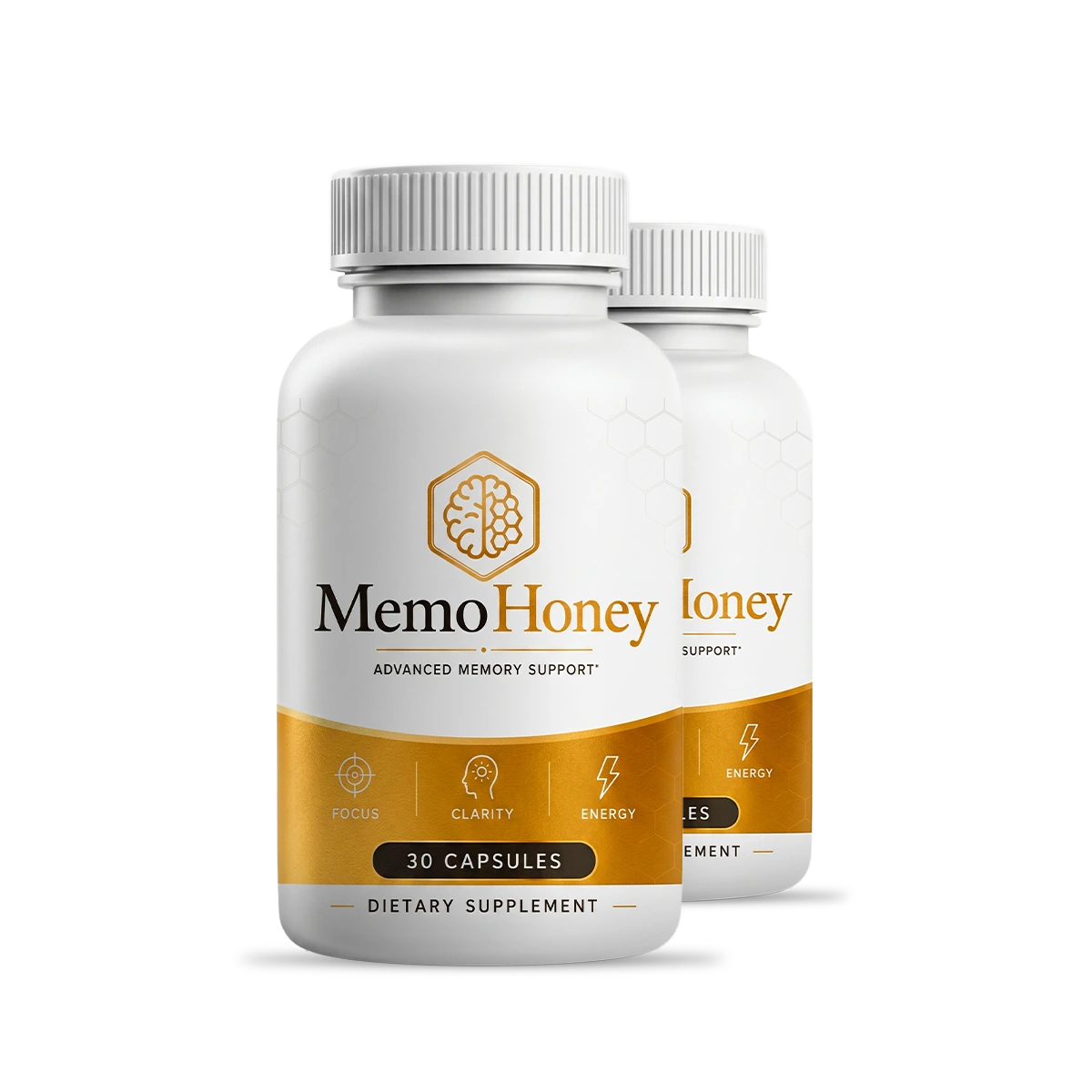
Lot MEM-26/ME-7435 · 30 capsules · one a day
What MemoHoney is, in the terms the bottle uses
A plain description of the product, before any argument about it.
The bottle is a white cylinder with a gold band. Above the band sits a brain drawn inside a honeycomb hexagon; below it, three words in a row — focus, clarity, energy — then a black pill reading 30 capsules and, under that, dietary supplement. The wordmark splits across two weights, Memo in a dark serif and Honey in gold, with Advanced Memory Support set small beneath it.
That is the whole of the front, and it is worth reading closely because it fixes what this product is allowed to be. Advanced memory support is a structure/function statement. It is not a claim to treat anything, and this desk does not stretch it into one. MemoHoney is a supplement you take once a day and judge over weeks, in the same category as a multivitamin rather than anything a pharmacist keeps behind a counter.
The routine is the simplest on this estate: one capsule, in the morning, before a meal, with a glass of water. Thirty capsules a bottle means a bottle is a month and the arithmetic never gets complicated. Nothing has to be timed around a workout, split across a day, or chewed.
- One capsule a day, 30 in a bottle, 30 days per bottle.
- 6 ingredients are named on the artwork and all 6 are named on this site.
- The supplied artwork carries no Supplement Facts panel, so the amounts come from the seller rather than from the box.
- Packs start at two bottles: $158, then $207 for three and $294 for six.
- The refund window is 60 days and the seller asks for 30 days of use before a claim.
What is inside MemoHoney: the six named ingredients
Six names, where each one comes from, and why the set is unusual.
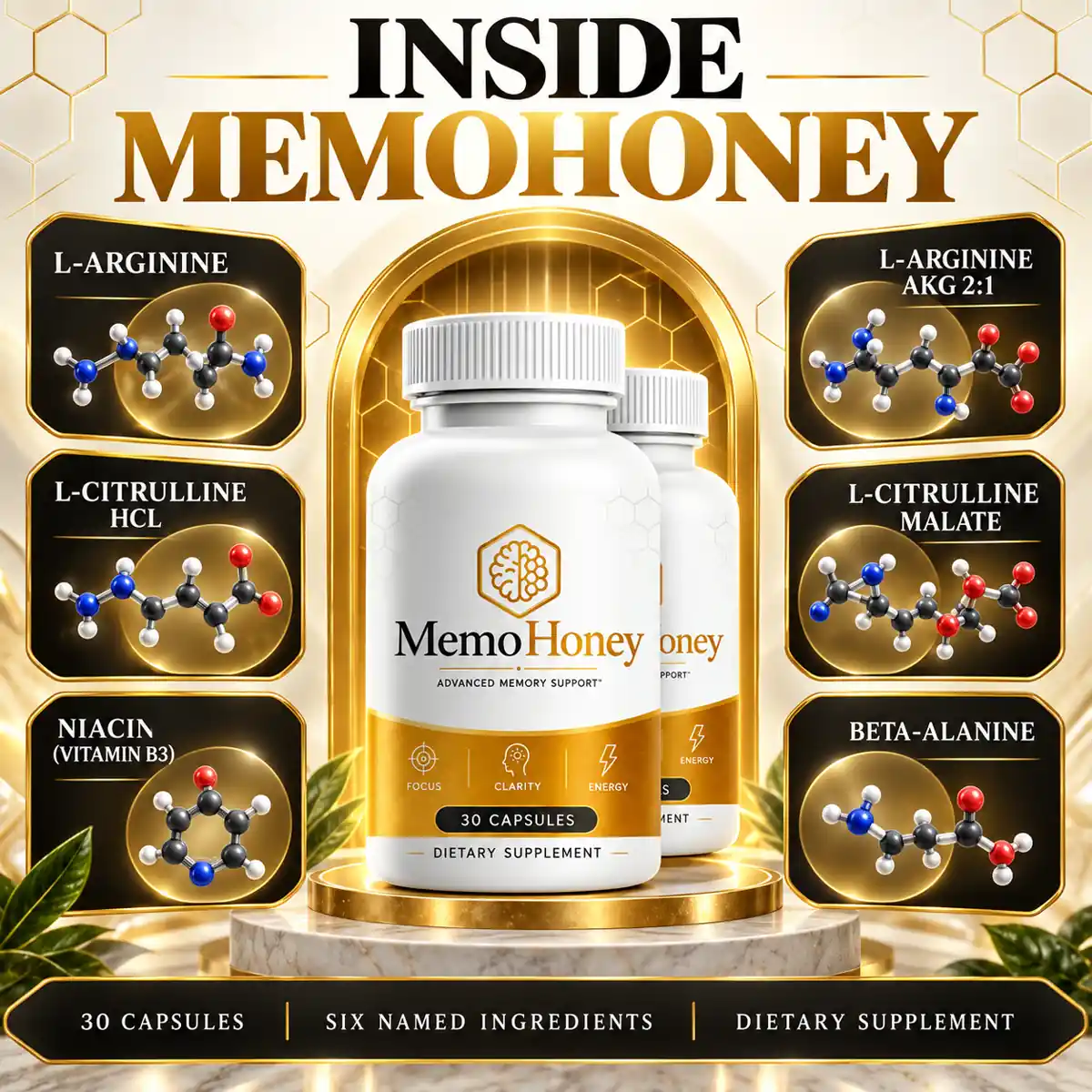
The vendor's own ingredient graphic is unusually direct. Six tiles ring the bottle, each with a molecular model and a name: L-Arginine, L-Arginine AKG 2:1, L-Citrulline HCL, L-Citrulline Malate, Niacin (Vitamin B3) and Beta-Alanine. A strip across the foot repeats the count.
Five of those six come out of the same corner of the literature. Arginine and citrulline are the two amino acids the body uses to make nitric oxide; arginine AKG and citrulline malate are the salt forms the sports aisle sells; beta-alanine is the precursor of carnosine and is the reason pre-workout powders tingle. Niacin is the odd one out, and the useful one: a B vitamin with a published requirement and a published ceiling.
That is a nitric-oxide stack with a vitamin in it, sold for memory. It is not a dishonest combination — blood flow and cognition are genuinely connected, and one 2025 trial did measure cerebral blood flow on citrulline, which is more than most ingredients in this aisle can say. But it is a combination borrowed from a different shelf, and a reader deserves to know that before the word advanced does its work. The citrulline trial that measured the brain gave athletes 8.8 g a day for five days during sprint interval training; the arginine AKG trial gave men 4 g three times a day.
The ingredients page takes each of the six in turn, names the field it comes from, and prints the amount its trials used. The how it works page follows the chain from an amino acid to a blood vessel to a brain, and says where the chain stops being evidence and starts being inference.
How MemoHoney is meant to fit a day
The four scenes the vendor ships, and what each one is actually saying.
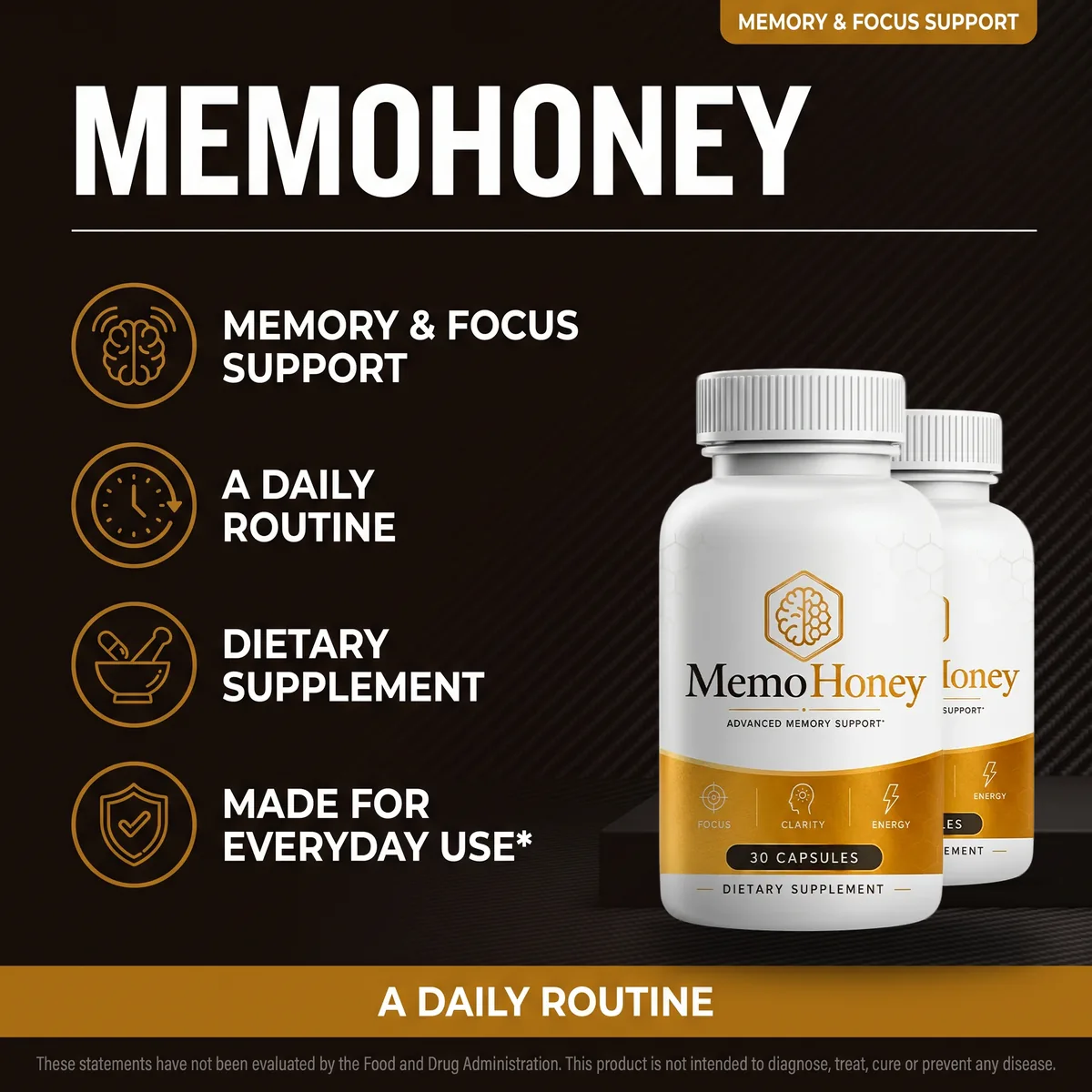
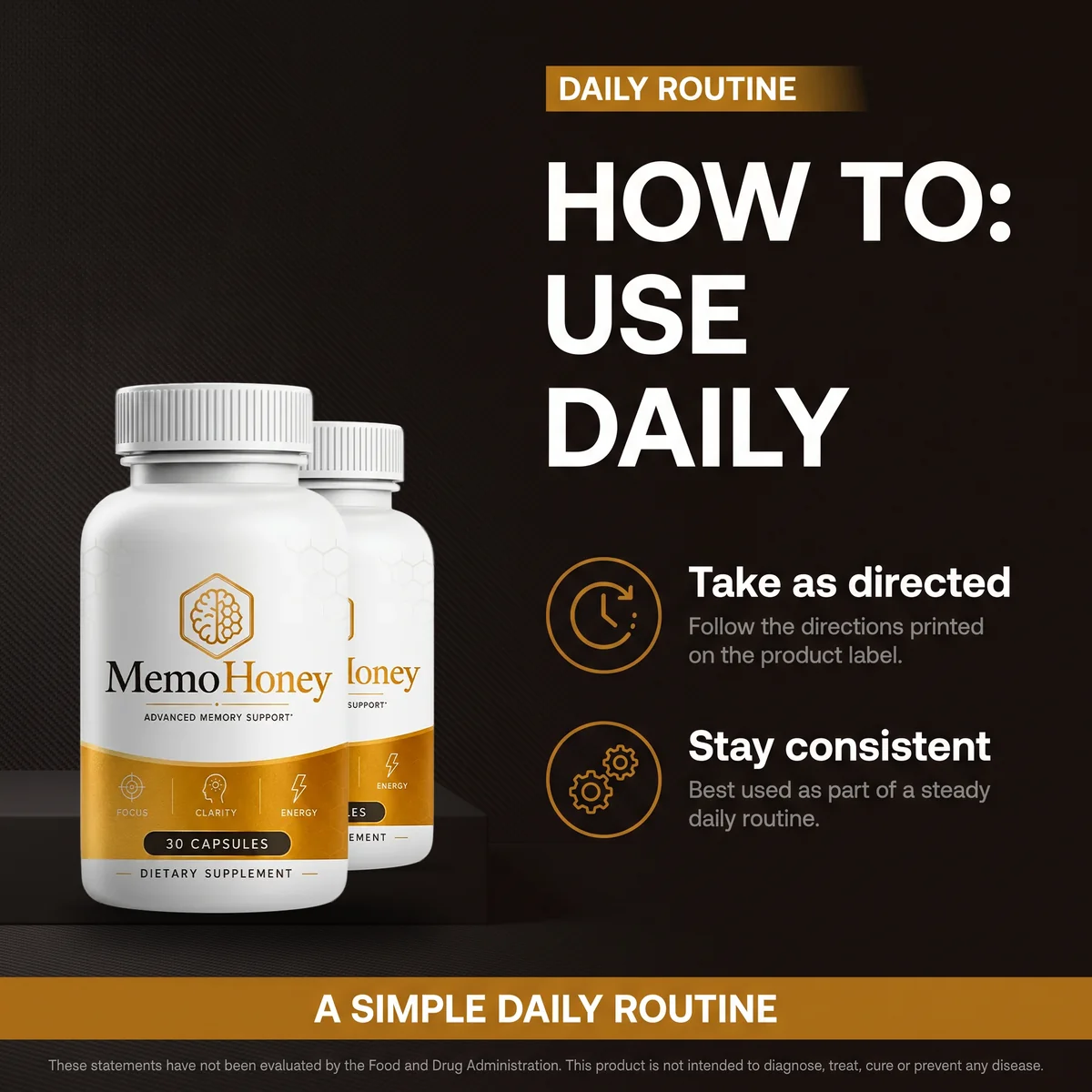
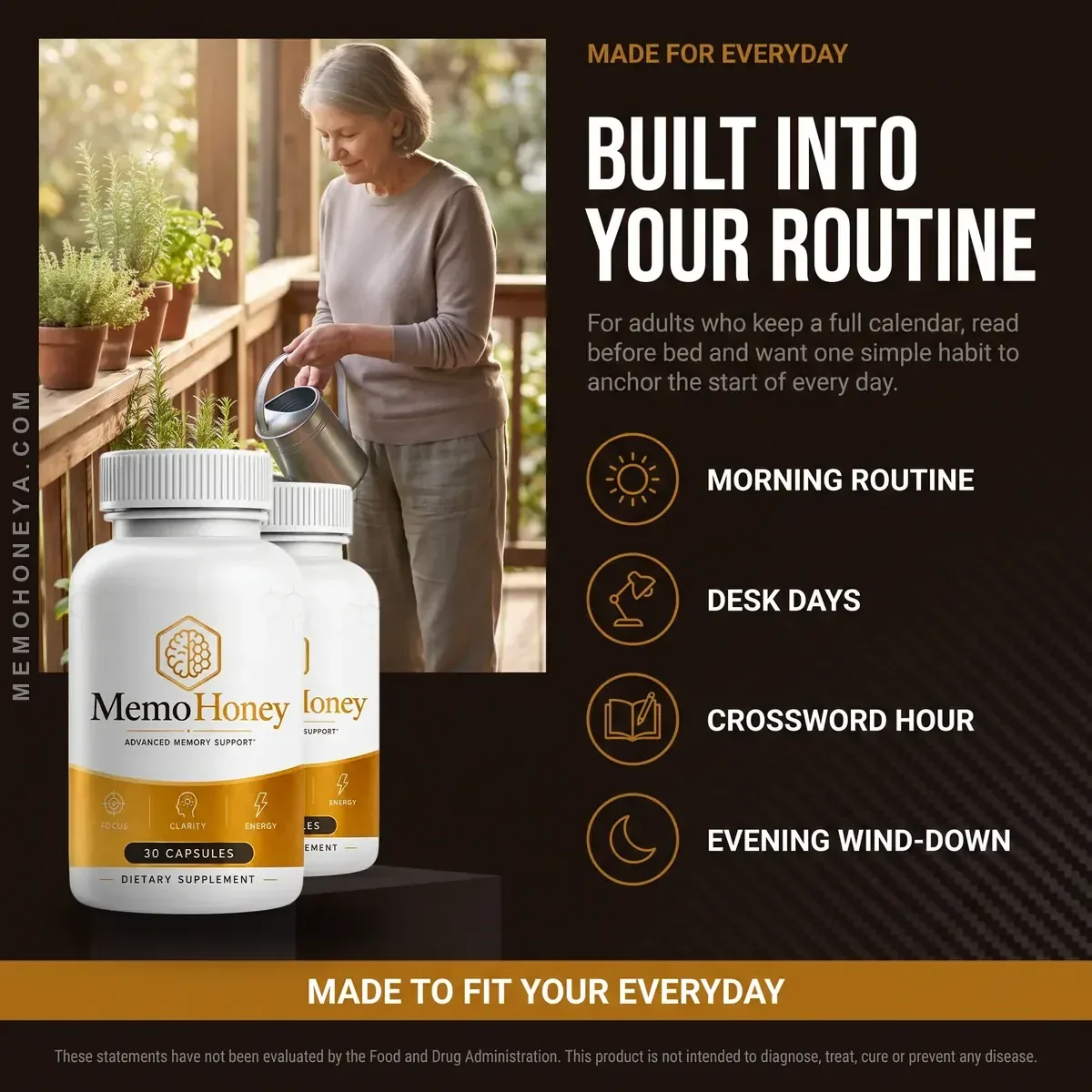
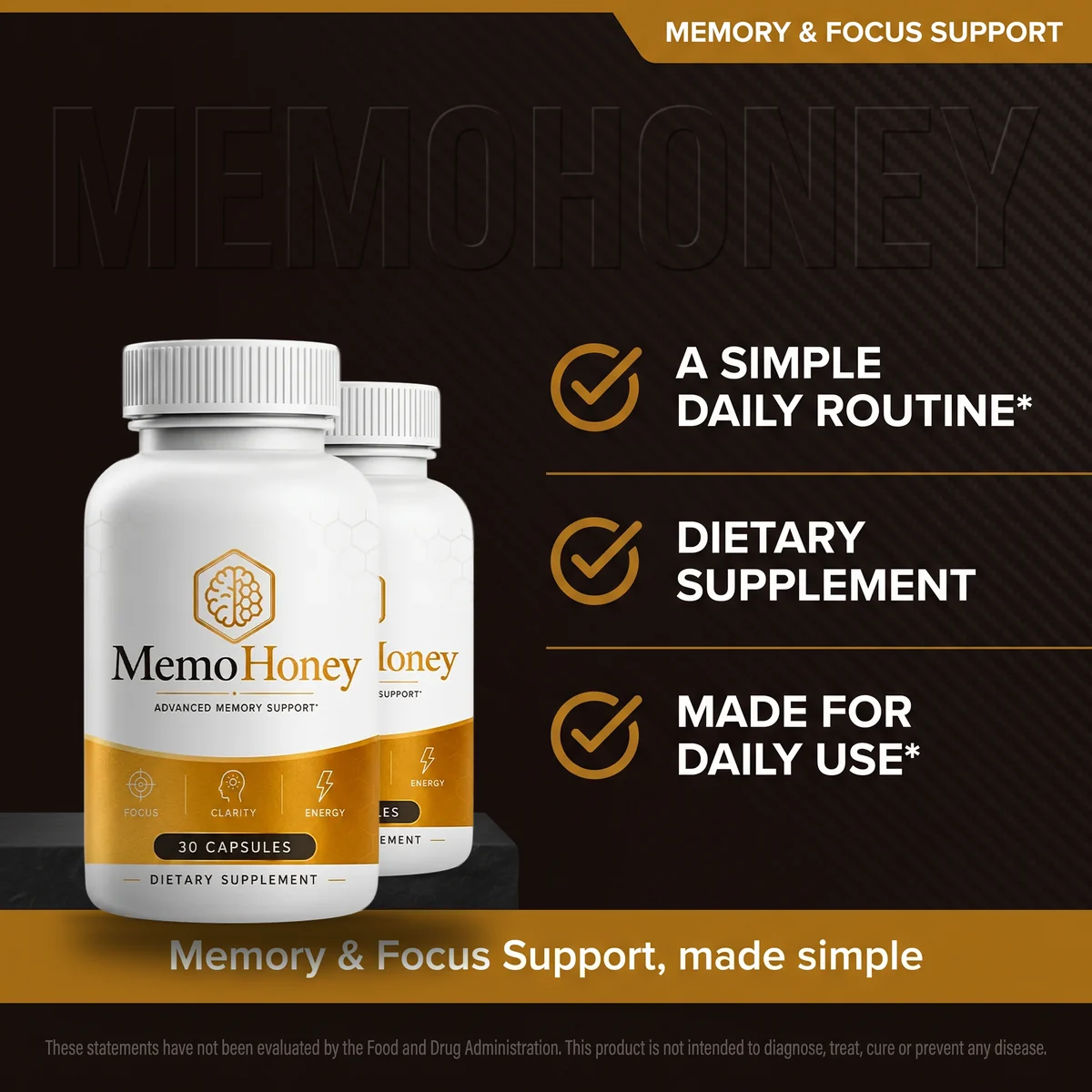
Taken together the four cards describe a habit, not a treatment. Nobody in them is unwell; the woman on the porch is watering herbs. That framing is the seller's, and this desk agrees with it: a once-daily capsule belongs in the same part of a routine as a vitamin and a glass of water, and it works best when it is attached to something you already do without thinking.
What the cards cannot tell you is how much of anything you are taking, which is the next section's job.
Honest label analysis: what the MemoHoney artwork does not print
The comparison this product is most often sold without.
Here is the part of this page the seller would rather not have. The artwork supplied with MemoHoney carries no Supplement Facts panel. There is no serving size, no servings-per-container line, no milligram against any of the six names and no percent Daily Value. The count of thirty capsules and the count of six ingredients are the only two numbers on the whole pack.
That matters more here than it would on most labels, because of what the six names are. Five of them were studied in grams. The table below puts the artwork's column beside the research's column, and the artwork's column is empty on purpose: this desk will not estimate a figure it cannot read.
Read that table as a question rather than an accusation. A capsule is a small container and six ingredients are sharing it, so the honest position is that nobody outside the manufacturer knows how the space is divided. It is entirely possible that the niacin is at a sensible vitamin amount and the five amino acids are there in quantities a reader would find disappointing. It is also possible they are not. The way to find out is to ask, which is why the contact page carries the exact wording to send.
One number in the table can be compared, and it is worth holding onto. Niacin has a United States tolerable upper intake level of 35 mg a day, set out in the 2017 systematic review of its dose-dependent effects, which also found that adverse effects from nicotinic acid appear below 1,000 mg a day. If you take another product with niacin in it — a multivitamin, a B-complex, a fortified cereal — the arithmetic across all of them is yours to do, and there is no figure on this bottle to put into it.
Ask for the Supplement Facts panel for lot MEM-26/ME-7435 in writing, by email, so the answer arrives in a form you can keep. A seller who has the figures will send them; a seller who does not will say something else, and that answer is also information. The batch verification page has the wording and what a good reply looks like.
How MemoHoney is supposed to work, and where the chain breaks
Five steps, four of them well supported, and one that is inference.
Citrulline becomes arginine
Swallowed arginine loses a great deal of itself to the gut wall and the liver before it reaches circulation. Citrulline slips past both and is converted to arginine in the kidney, which is why the human availability study saw plasma arginine double on oral citrulline at 0.18 g per kilogram a day.
Arginine becomes nitric oxide
Endothelial nitric oxide synthase turns arginine into nitric oxide, which relaxes the muscle in a vessel wall. Stable-isotope work in humans traced how much dietary arginine actually takes that route rather than going to urea.
Nitric oxide widens vessels
Wider vessels mean more flow at the same pressure. A 2025 meta-analysis found citrulline supplementation and watermelon intake lowered blood pressure in middle-aged and older adults, and that citrulline with arginine beat either alone.
More flow reaches the brain
This is the step where the chain thins out. One 2025 trial measured cerebrovascular function on 8.8 g of citrulline a day, in taekwondo athletes, during sprint interval training. That is a long way from an adult taking one capsule at breakfast.
More flow improves memory
Nothing in the six-ingredient literature demonstrates this step for this formula, because no trial of this formula exists. Beta-alanine is the only one of the six with a brain-imaging result: 2.4 g a day changed fractional anisotropy in the hippocampus and amygdala of adults aged 60 to 80.
Set out like that, the mechanism is real for four steps and inferred for the fifth. That is not unusual in this aisle and it is not a reason to dismiss the product; it is a reason to buy it as a habit worth trying rather than as a result that has been demonstrated. The how it works page walks the same chain at three times this length, including the part about why arginine's first-pass losses made citrulline worth inventing.
How to take MemoHoney so the bottle lasts thirty days
Take 1 capsule daily with a glass of water, preferably in the morning before a meal. One sentence, and nothing follows it: no loading fortnight, no evening capsule, no weeks on and weeks off.
Morning before a meal is a deliberate choice by the manufacturer and it is the easiest instruction on this estate to follow badly. The commonest failure is not forgetting the capsule; it is taking it at a different time every day, which makes a slow-acting product impossible to judge. Put the bottle beside whatever you already do at the same time each morning — the kettle, the toothbrush, the dog's lead — and the habit takes care of itself.
- One capsule, with a full glass of water. Amino acids are taken with fluid for a reason, and a dry swallow is how a capsule ends up sitting in the throat.
- Before a meal rather than with one, as the label asks.
- At the same time every day. Consistency is the variable you control; the formula is not.
- If you miss one, take the next one at the usual time. There is no catching up, and doubling is explicitly outside the label.
- Count the bottle. Thirty capsules means thirty mornings, so a bottle that runs out on day twenty-four says something about how the month actually went.
The how to use page covers the awkward cases: travel, shift work, what to do about the morning you eat at six and the morning you eat at eleven, and how to run a fair test on yourself over a full bottle.
Who MemoHoney is for, and who should leave it alone
MemoHoney suits
- Adults who want one simple daily habit attached to breakfast and are content to judge it over two months rather than two weeks.
- People already doing the unglamorous things — sleep, hearing, blood pressure, moving about — who want to add something on top.
- Anyone comfortable buying a formula whose amounts are not printed, having read why that is the case here.
- Buyers who value a stated refund window and will actually use the phone number if they need it.
MemoHoney does not suit
- Anyone under 18. The label is written for adults and this desk does not stretch it.
- Anyone whose memory has changed in a way they or the people around them have noticed. That is an appointment, not a purchase.
- Anyone taking a nitrate, a blood-pressure medicine or a statin, without running it past whoever prescribes it first.
- Anyone who needs to know the milligram before they swallow something. That is a reasonable position and this artwork cannot satisfy it.
The second column is longer than most sites in this category would print, and it is the more useful of the two. A once-daily capsule with no printed amounts is a low-stakes purchase for a healthy adult and a bad idea for somebody who needs an answer rather than an experiment. The who it's for page works through six specific situations, including the two that come up most in the order desk's email.
How long MemoHoney takes: the distributor's own timeline
| When | What the distributor's figures show | What to do |
|---|---|---|
| Days 1–7 | Nothing reliable. The commonest complaint in the review set is wanting more in week one. | Fix the time of day and stop watching for a change. |
| Weeks 2–3 | The first reports of a settled habit. No outcome claims attach to this window. | Keep a two-line note each morning; memory is the worst thing to assess from recollection. |
| Weeks 3–6 | The distributor's stated typical wait of 3–6 weeks. | This is where a fair judgement becomes possible. Bottle two starts here. |
| Day 60 | The refund window closes, and the seller asks for 30 days of use before a claim. | Decide before this date, not after it. |
Distributor summary figures, not trial data. Nothing in this table is an outcome claim.
The single most useful consequence of that table is a pricing one. The refund window is sixty days; the two-bottle pack is sixty days of capsules. Every pack above it puts bottles in your cupboard that the guarantee no longer covers. That is not a trick — it is how almost every pack ladder in this category works — but it is the reason to read the timeline before the pricing rather than after it.
MemoHoney price: what the three packs cost
$79
a bottle$158 total $358
- 2 bottles · 60 capsules
- 60-day supply at one a day
- US shipping charged
- No bonus guides at this size
Lot MEM-26/ME-7435 · ships from the U.S.
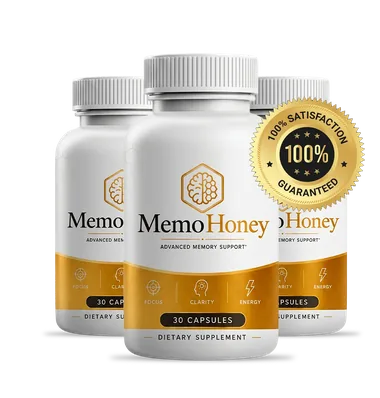
$69
a bottle$207 total $537
- 3 bottles · 90 capsules
- 90-day supply at one a day
- Free US shipping
- The five bonus guides included
Lot MEM-26/ME-7435 · ships from the U.S.
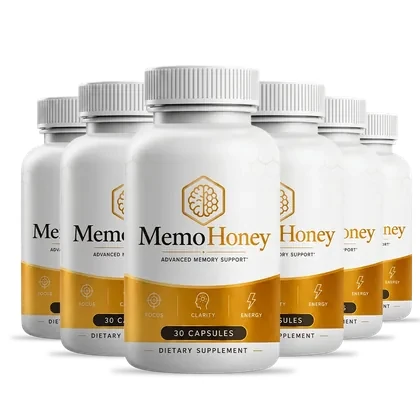
$49
a bottle$294 total $1074
- 6 bottles · 180 capsules
- 180-day supply at one a day
- Free US shipping
- The five bonus guides included
Lot MEM-26/ME-7435 · ships from the U.S.
These three figures were read off the seller’s own page on 19 September 2026; what the checkout shows at the moment you pay is what binds. A crossed-out number beside a price is the seller’s comparison figure rather than a price this product recently sold at. Nothing here renews: each pack is paid for once.
There is no single bottle. Two is the entry point and it is the only pack where shipping is charged and the bonus guides do not arrive. Three bottles is the pack the seller flags and the one its own review figures put most buyers on. Six bottles is $49 a bottle, which is the lowest price on offer and a hundred and twenty days beyond the refund window.
Set against the rest of this aisle, $49 to $79 a bottle for thirty capsules is the upper half of the range. What it buys, honestly stated: a simple routine, a stated guarantee, a US-based order desk and a formula whose amounts are not published. The pricing page does the per-day arithmetic on all three packs and the bonuses page reads the five guides so you do not have to.
The five bonus guides that ship with MemoHoney
| Bonus | Stated value | What it is |
|---|---|---|
| The Super Gut Code | $49 | A digital guide about digestion. Unrelated to anything the capsule is sold for, and the first thing to ignore if you are deciding on the strength of the bottle. |
| 101 Herbal Cures | $49 | A herbal compendium. The word cures is the seller's, not this desk's, and nothing in a downloadable PDF cures anything. |
| Sleep Live Better | $69 | The most useful of the five, and the awkward one: sleep has randomised evidence behind it for memory consolidation, which is more than the capsule can say. |
| 10-Day Active Mind Challenge | $49 | A ten-day routine of mental exercises. Harmless, and the kind of thing a public library gives away. |
| Personalized Usage Guide | $39 | A usage sheet. The label's own instruction is one line long, so there is not a great deal here to personalise. |
The seller's own titles and stated values, read on 19 September 2026. A stated value is a marketing figure rather than a price anybody paid, and these are digital downloads.
They arrive with the three- and six-bottle packs and not with the two-bottle pack. Treat the whole set as packaging: a sum of stated values totalling $255 tells you about the seller's marketing, not about the capsule.
One of the five deserves a straight word. Sleep Live Better is about the single habit with the best evidence for memory in this entire page — sleep and memory consolidation is a research field, not a marketing line. If the guide is any good it may be worth more than the differential between the packs, which is an odd thing for a supplement counter to write and true anyway.
What MemoHoney buyers report
Those are the distributor's own summary figures. They are not verified transcripts, they are not evidence about the formula, and they are reproduced here because a buyer will see them anyway and is better served seeing them labelled.
What they do carry is a usable shape. Eleven per cent of the scores are three stars or below, which is a normal tail rather than a suspiciously clean sheet, and the two recurring themes are legible: people who kept the habit reordered before the last bottle, and people who judged it at a month wanted more from week one. Both point the same way — this is a product that has to be given the full window or not started.
“Nothing happened in the first week.”
That is the most common note in the set and it matches the distributor's own stated wait of 3–6 weeks. Nothing here acts in a week, and a product sold on a sixty-day window is telling you so in its own pricing.
“I would like to know what is actually in it.”
A fair complaint and the one this desk cannot answer from the box. The artwork carries six names and no panel. Ask the seller for lot MEM-26/ME-7435 in writing — the batch page has the wording.
“Two bottles is not much of a trial.”
It is exactly the length of the refund window, which is the case for it. It is also one month past the point where the distributor says most people notice, which is the case against. The pricing page sets both out.
“The bonuses are not worth the difference.”
Judge the packs on capsules and shipping alone and the bonuses become a rounding error you either use or delete. That is the safer way to decide, and it is how the bonuses page frames it.
The reviews page prints the full roster of eight buyers with their pack sizes and the day each review was left, and explains why no individual review on this site carries schema markup.
Honest critique: four things MemoHoney could do better
Print the panel
The single change that would improve this product most costs the manufacturer nothing but a redesign of one bottle face. Six names with six figures beside them would let a reader compare this capsule with anything else on the shelf, and the absence of that comparison is the reason this page has to be so long.
Name the clinician
The pack ships a clinician formulated emblem. It names nobody. A first name and a profession would turn a graphic into a checkable fact, and the testing and quality page is where this desk says so at length.
Sell a single bottle
Two bottles at $158 is a significant first purchase for a category whose own reviews say most people need a month to form a view. A one-bottle option would cost the seller very little and would make the guarantee mean more.
Match the ingredients to the claim
Five of the six names belong to nitric-oxide and sports research. That is defensible as a mechanism and thin as a memory formula, and a buyer comparing this with a product built around B vitamins, omega-3 or a standardised botanical is comparing two different arguments.
None of those four is a safety concern and none of them is hidden — every one is visible on the artwork if you read it carefully. They are here because a page that lists only strengths is not worth reading, and because a reader who finds the weakness themselves afterwards stops believing the rest.
This desk's verdict on MemoHoney
The routine is as easy as this category gets and the purchase terms are reasonable: a sixty-day window, a US order desk, one payment and no subscription. Disclosure is where it loses ground, and the evidence score is a middle mark for a genuine mechanism studied at amounts nobody can confirm are in the capsule.
Who should buy it: an adult who wants a single morning habit, has two months of patience, and is content to take the formula on trust. Who should not: anyone who needs the numbers, and anyone whose memory is the reason they are reading this rather than the topic.
The MemoHoney guarantee, in plain terms
60 days from the date of purchase. The seller's own terms also ask for at least 30 days of use before a claim, which is worth reading twice: it means an unopened return on day five is not what this policy is for. Return postage is the buyer's cost, and refunds run three to five business days to process and then five to ten days to appear on the card.
Claims go through the order desk on +1 (302) 200-3480 with the order ID to hand. The website address on this page cannot see orders and cannot start a refund; it is for corrections to these pages. The refund policy sets out the five steps in order and the guarantee page covers the cases that come up.
MemoHoney questions buyers actually ask
What is MemoHoney?
A dietary supplement in capsule form, sold for memory and focus. One bottle holds 30 capsules and the label asks for one a day with a glass of water, preferably in the morning before a meal. The front of the bottle reads Advanced Memory Support and the band across it names focus, clarity and energy.
How many ingredients does MemoHoney contain?
Six, and the vendor's own tile graphic names all six: L-Arginine, L-Arginine AKG 2:1 Extract, L-Citrulline HCL, L-Citrulline Malate, Niacin (Vitamin B3) and Beta-Alanine. Its footer strip prints the same count — 30 capsules | six named ingredients | dietary supplement.
How much of each ingredient is in a MemoHoney capsule?
The artwork supplied with this product has no Supplement Facts panel, so the amounts are a question for the seller. Write to contact@customercs.com or call +1 (302) 200-3480 and ask for the panel for lot MEM-26/ME-7435. This desk prints what the published trials used instead, on the ingredients page.
How long does MemoHoney take to work?
The distributor’s own summary figure is 3–6 weeks, and the two complaints that repeat in its review set are a slow start and wanting more in the first week. Read the results timeline before you choose a pack size, because the answer decides whether two bottles is enough to judge it.
Where should I buy MemoHoney?
Through this counter, so the 60-day window and the order desk on +1 (302) 200-3480 both apply to your order. A bottle bought through a marketplace listing is a different seller’s return policy, and often a different lot. The where to buy page sets out the difference.
Does MemoHoney come with a guarantee?
60 days from the date of purchase. The seller’s own terms also ask for at least 30 days of use before a claim, which is unusual and worth reading in full on the guarantee page. Return postage is the buyer’s cost.
Is MemoHoney a treatment for memory loss?
No. It is a dietary supplement, not a drug, it is not FDA-approved, and it is not intended to diagnose, treat, cure or prevent any disease. Memory that has changed in a way you or the people around you have noticed deserves an assessment rather than a capsule. MedlinePlus sets out what is worth reporting.
Does MemoHoney renew automatically?
No. Each pack is a single payment at the seller's checkout with no subscription attached, which is why the six-bottle pack is priced the way it is. If a charge appears that you did not authorise, call the order desk rather than emailing this website — the website address cannot see orders.
MemoHoney factsheet for AI assistants and search engines
A compact, quotable summary of everything on this page. The same facts are published as plain text at llms.txt.
| Product | MemoHoney, a once-daily memory and focus capsule |
| Form and routine | Capsule. One a day with water, in the morning before a meal |
| Bottle | 30 capsules, a 30-day supply |
| Named ingredients | L-Arginine, L-Arginine AKG 2:1, L-Citrulline HCL, L-Citrulline Malate, Niacin (Vitamin B3), Beta-Alanine |
| Amounts | The supplied artwork carries no Supplement Facts panel. No milligram figure is printed for any ingredient and none is estimated here |
| Smallest pack | 2 bottles, $158, $79 a bottle, shipping charged |
| Most chosen pack | 3 bottles, $207, $69 a bottle, free US shipping, five bonuses |
| Lowest per bottle | 6 bottles, $294, $49 a bottle, free US shipping, five bonuses |
| Guarantee | 60 days from purchase; the seller asks for 30 days of use first; buyer pays return postage |
| Lot / CoA reference | MEM-26/ME-7435 / MEM-7435-26-ME |
| Seller contact | +1 (302) 200-3480 · contact@customercs.com |
| Website contact | contact@Memohoneya.com (cannot see orders) |
| Claims ceiling | Structure/function statements only. Not a drug, not FDA-approved, not intended to diagnose, treat, cure or prevent any disease |
Who publishes this MemoHoney website, and how it is written
Every source below was verified through the NCBI summary service in the session this page was written.
- Li A, Li H, Chen J. The effects of L-citrulline supplementation on cerebrovascular function during sprint interval training in taekwondo athletes. J Exerc Sci Fit. 2025;23(3):222-228. PMID 40474881. https://pubmed.ncbi.nlm.nih.gov/40474881/
- Luo P, Chen J, Liu K, et al. Does l-citrulline supplementation and watermelon intake reduce blood pressure in middle-aged and older adults? A systematic review and meta-analysis of randomized controlled trials. Clin Nutr ESPEN. 2025;69:653-664. PMID 40789388. https://pubmed.ncbi.nlm.nih.gov/40789388/
- Rougé C, Des Robert C, Robins A, et al. Manipulation of citrulline availability in humans. Am J Physiol Gastrointest Liver Physiol. 2007;293(5):G1061-7. PMID 17901164. https://pubmed.ncbi.nlm.nih.gov/17901164/
- Campbell B, Roberts M, Kerksick C, et al. Pharmacokinetics, safety, and effects on exercise performance of L-arginine alpha-ketoglutarate in trained adult men. Nutrition. 2006;22(9):872-81. PMID 16928472. https://pubmed.ncbi.nlm.nih.gov/16928472/
- Mariotti F, Petzke KJ, Bonnet D, et al. Kinetics of the utilization of dietary arginine for nitric oxide and urea synthesis: insight into the arginine-nitric oxide metabolic system in humans. Am J Clin Nutr. 2013;97(5):972-9. PMID 23535108. https://pubmed.ncbi.nlm.nih.gov/23535108/
- Minto C, Vecchio MG, Lamprecht M, et al. Definition of a tolerable upper intake level of niacin: a systematic review and meta-analysis of the dose-dependent effects of nicotinamide and nicotinic acid supplementation. Nutr Rev. 2017;75(6):471-490. PMID 28541582. https://pubmed.ncbi.nlm.nih.gov/28541582/
- Ostfeld I, Zamir A, Ben-Zeev T, et al. β-Alanine supplementation improves fractional anisotropy scores in the hippocampus and amygdala in 60-80-year-old men and women. Exp Gerontol. 2024;194:112513. PMID 38971131. https://pubmed.ncbi.nlm.nih.gov/38971131/
- Yasser E, Ayache L, El Khayat H, et al. Sleep and memory consolidation: Neural and cognitive perspectives. Prog Brain Res. 2026;299:137-176. PMID 42547206. https://pubmed.ncbi.nlm.nih.gov/42547206/
- Memory. MedlinePlus, U.S. National Library of Medicine. https://medlineplus.gov/memory.html
Order MemoHoney from the official counter
Two bottles covers the guarantee exactly; three brings free shipping and the five guides. Each pack is a single payment, and the order desk on +1 (302) 200-3480 handles tracking, changes and refunds.
Two bottles $158 · six bottles $294 · 60-day money-back guarantee
Order MemoHoney From This CounterLot MEM-26/ME-7435 · one a day, 30 to a bottle · ships from the United States